Park, landscape and Gaudí
Park Güell
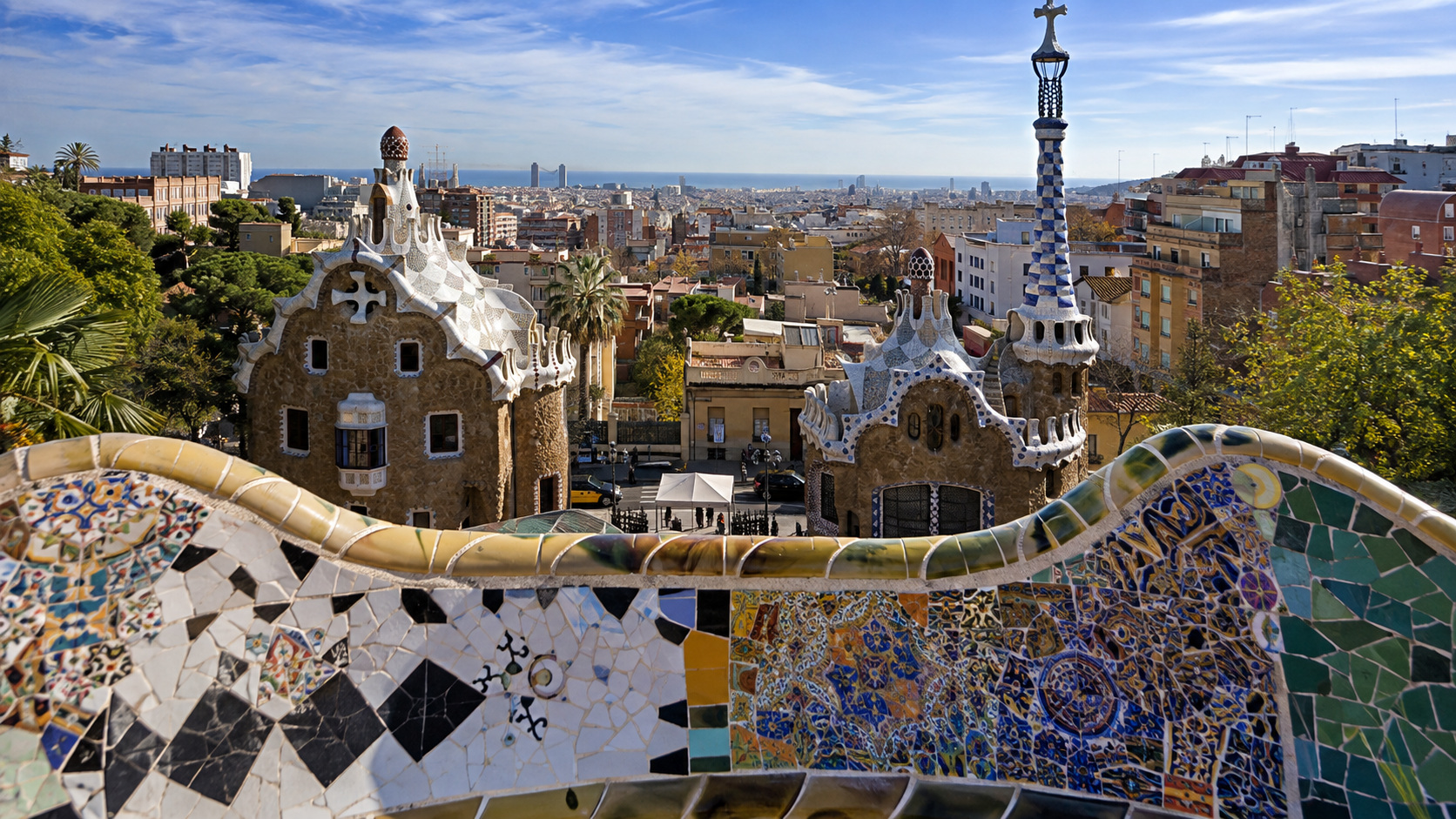
Park Güell is a park landscape designed by Antoni Gaudí on the hills on the north side of the compact centre. The project started as a residential development commissioned by Eusebi Güell and later grew into a public park. Architecture, relief, nature and view lines are part of one coherent design.
Park Güell tickets: time slots and planning
Park Güell uses timed admission. The official website allows entry up to 30 minutes after the time printed on your ticket; after that window, admission is lost. Leave enough travel time to reach the entrance.
Once inside, you can explore at your own pace during opening hours, but you cannot re-enter after leaving. Everyone needs the appropriate admission ticket, including children eligible for free entry. Morning periods reserved for residents are not tourist visiting hours.
Our planning advice: combine the park with a walk through Gràcia rather than several large interiors in the same half-day. Allow for travel time before your next reservation.
Explore Gràcia · Fit Park Güell into three days
Official sources checked on 10 September 2026: entry times · ticket types. Check the latest conditions before buying.
Park Güell at a glance
Choose Park Güell for architecture combined with a walk over hilly ground. If you mainly want a green place to sit between visits, Ciutadella is a simpler option. Allow time to reach Park Güell’s entrance: arriving in the neighbourhood is not the same as being ready for your timed admission. The original plan for a residential park was not realized according to the initial ambitions. The constructed infrastructure and monumental components show how Gaudí wanted to connect buildings and landscape. The park later became municipal property and was given a public park function in the twentieth century.
Origin. The project started as a residential development and later became a public park.
Landscape. Paths, height differences and structures follow and reinforce the terrain.
Material. Stone, ceramics and reused fragments contribute to the recognizable design.
Visit. Access, capacity and available routes may change; check current information officially.
What can you see in Park Güell?
View Park Güell as a nexus of architecture, infrastructure and landscape, not just as a series of photo points.
Entrance pavilions. The buildings at the main entrance were part of the original residential park plan.
Monumental staircase. Stairs, water and ceramics together form the structure of the entrance area.
Hypostyle room. The column space combines a supporting structure with a role in water management.
Nature square and undulating bench. The square, edge, view and underlying room are spatially connected.
Viaducts and porches. Passages and support structures fit in with the relief of the terrain.
Landscape and planting. The park is also a hilly walking area with paths and plants.
Visit idea
A logical walk through Park Güell
This example sequence connects monumental components and landscape. The actual walking direction may depend on the entrance, access zones and activities.
Entrance→Stairs and pavilions→Hypostyle room→Nature Square→Viaduct
- Step 1
Orient yourself at the entrance
Check route, elevation changes and available zones.
- Step 2
View stairs and pavilions
Place the individual shapes in the structure of the entrance area.
- Step 3
Go to the Hypostyle room
Note the load-bearing structure and the relationship with the square above it.
- Step 4
Walk along the square, bench and view lines
Take into account varying crowds and visibility conditions.
- Step 5
Explore a portico or viaduct
End with the interplay of stone, path, plants and terrain.
How architecture and landscape come together
Gaudí brought together local materials, the existing terrain, supporting structures, water drainage and plants. As a result, the stone viaducts, paths and monumental zone are parts of one landscape system; the park consists of more than colorful mosaics.
For architecture
View entrance area, Hypostyle room and porches.
For landscape
Pay attention to routes, relief, plants and view lines.
For details
Compare stonework, trencadís and structural forms.
Before you visit
Control access. Please check official availability in advance.
Choose your arrival route. Adjust the route to mobility and height differences.
Wear suitable shoes. Paths can be sloping and uneven.
Prepare for weather. Bring appropriate protection based on current conditions.
Plan Gràcia separately. A walk from Vila de Gràcia is not automatically short or flat.
Check work. Temporary restrictions may change the route.
Continue nearby
Choose combinations based on your time and interest; multiple extensive visits do not naturally fit into one short half-day.
Gràcia. Vila de Gràcia is located lower and forms a separate neighbourhood visit.
Casa Vicens. This modernist house can be viewed as a separate architectural visit.
Other works by Gaudí. Sagrada Família, Casa Batlló and Casa Milà each require a separate choice.
Frequently asked questions
What is special about Park Güell?
Architecture, infrastructure and landscape are designed as a coherent whole.
Is Park Güell located in the Gràcia district?
It is located in the La Salut district, within the larger Gràcia district, and not in Vila de Gràcia.
Can you visit Park Güell without a reservation?
That depends on the current zone and access method. Check official information in advance.
How much time do you need for Park Güell?
That depends on the route, zones, height differences and walking pace; there is no fixed duration.
Is Park Güell completely flat and barrier-free?
No. The terrain is hilly and routes vary. Check official accessibility information for your chosen route.