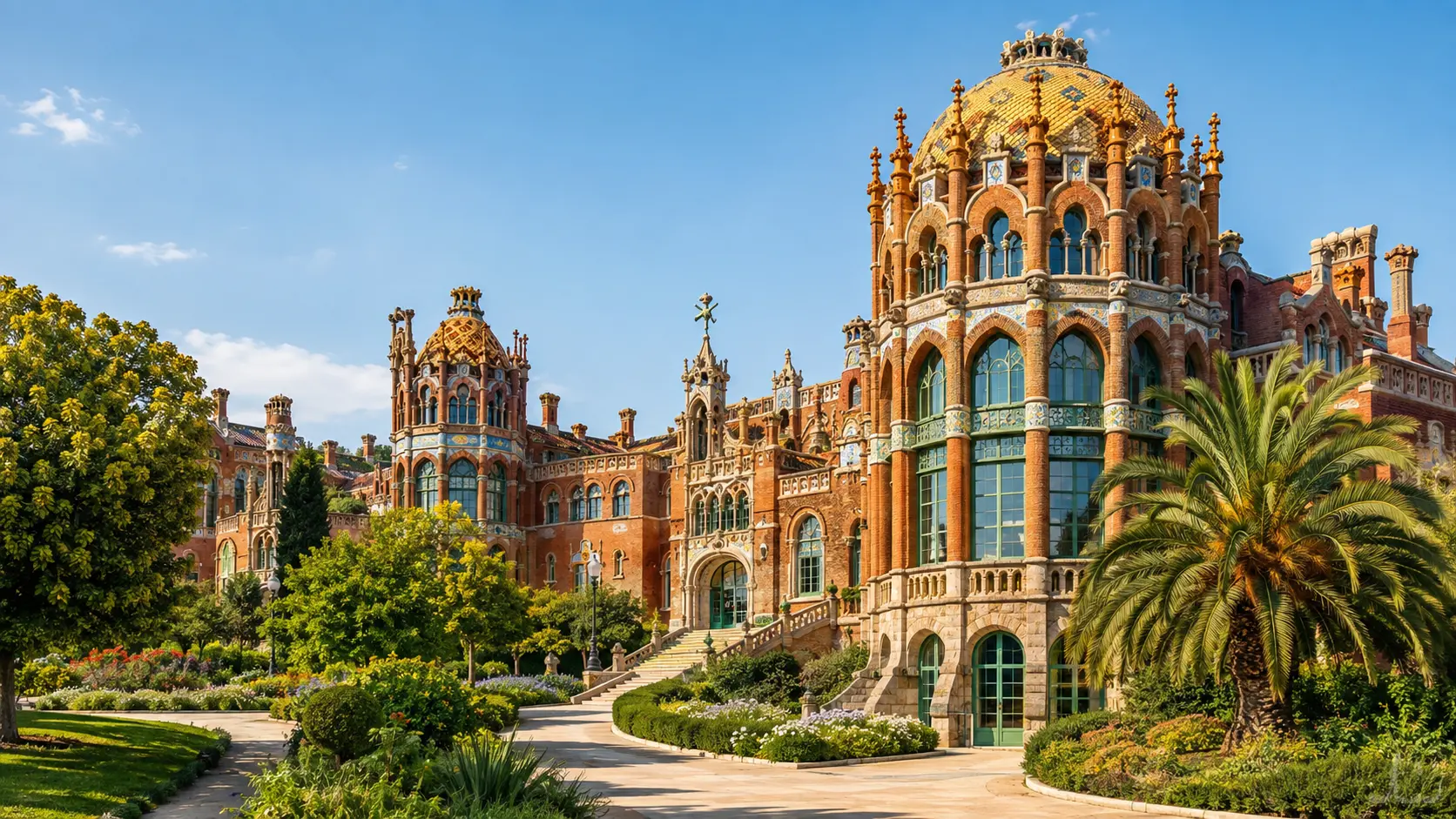
Landmark in Barcelona
Visit Hospital de Sant Pau
The historic complex of Hospital de Sant Pau consists of modernist pavilions, gardens and underground connections that together provide a special image of hospital architecture from the early twentieth century. A visit is not just about decoration, but also about the coherence between architecture, light, greenery and the former care function.
Visit Hospital de Sant Pau at a glance
Sant Pau suits a visit focused on architecture as a whole: pavilions, gardens and connecting spaces belong together. Look beyond the decorated façades to how light and open space are distributed between the buildings. Avinguda de Gaudí makes a walk towards Sagrada Família a natural continuation. The complex was designed as a coherent care environment in which separate pavilions, open space and connections formed a functional whole. The visitable Recinte Modernista and the adjacent current hospital have different functions.
Architecture. Brick, ceramics, glass, sculpture and spatial planning come together in one complex.
Care history. The buildings show how architecture and ideas about healthcare were connected in their time.
Pavilions and gardens. The individual buildings and green spaces in between are essential to the design.
World Heritage. The historic complex, together with Palau de la Música Catalana, forms the UNESCO World Heritage Site of Domènech i Montaner.
What can you see at Hospital de Sant Pau?
View the site as an architectural ensemble. Don't just focus on one facade, but also on routes, materials and the relationship between indoor and outdoor spaces. Check current access officially.
Administration Pavilion. The representative main building is a logical starting point to understand scale, symmetry and decorative development.
Pavilions. The individual pavilions show family resemblance and differ in details and former function.
Ceramics, glass and sculpture. Applied art is a visible part of the architecture.
Gardens and open space. The outdoor space supports the design and makes the coherence between the pavilions legible.
Underground connections. Corridors connected parts of the former hospital; officially check what is currently visitable.
Line of sight towards Sagrada Família. The Avinguda de Gaudí forms an urban sight line and possible combination, but is not part of the complex.
Viewing route
View Hospital de Sant Pau step by step
This example structure helps to read the complex as a whole. The current visitor route always takes precedence.
Entrance and main facade→Main building→Pavilions→Gardens and details→Ensemble
- Step 1
Start with the big picture
View the main facade and the location of the historic complex.
- Step 2
Read the spatial structure
Use the main building to understand scale and order.
- Step 3
Compare pavilions
Note similarities and differences in shape and detail.
- Step 4
Walk through the gardens
View materials, sight lines and spacing.
- Step 5
Conclude with the ensemble
Reinsert the individual buildings into the overall design.
Architecture and healthcare history of Sant Pau
The complex is mainly connected to Lluís Domènech i Montaner and was completed in a later phase by Pere Domènech i Roura. The historic hospital function explains the spatial planning, without confusing the visitable heritage site with the current hospital.
For architecture
Focus on pavilions, materials and spatial coherence.
For history
Use official explanations to place the development of the hospital and complex.
For a shorter visit
Choose the main building, some pavilions and one overview point.
Who is Hospital de Sant Pau interesting for?
Lovers of modernism. The pavilions and applied arts form one architectural ensemble.
Those interested in the city and healthcare history. The complex connects urban development with a former hospital function.
Visitors to Sagrada Familia. Both monuments can be combined via Avinguda de Gaudí.
Interest, available time, current accessibility and mobility determine how extensive the visit will be.
Accessibility and exercise at Hospital de Sant Pau
Check the visitor entrance. Consult the current entrance of the Recinte Modernista in advance.
Distinguish both functions. The historic complex and the current hospital are not the same purpose of visit.
Plan the urban walk. A combination with Sagrada Família runs along Avinguda de Gaudí.
Control specific access. Consult official information for route, lifts and pavilions.
Before you visit
Check current access in advance. Please use the official provider for changeable information.
Start with the big picture. First place buildings in their spatial context.
Compare multiple pavilions. Note family similarities and differences.
Pay attention to applied arts. View ceramics, glass and sculpture as architecture.
Don't plan every interior. Access may vary per section.
Combine targeted. Choose at most one nearby sequel.
Continue nearby
Choose combinations based on your time and interest; multiple extensive visits do not naturally fit into one short half-day.
Sagrada Família. Avinguda de Gaudí forms a clear urban connection.
Gràcia. Parts of the larger district offer a different street scene and require a targeted choice.
Eixample. Use Sant Pau as a starting point for a selective architecture walk.
Frequently asked questions
What can you see at Hospital de Sant Pau?
The historic complex includes modernist pavilions, gardens, decorative details and, where currently accessible, other parts of the Recinte Modernista.
Is Hospital de Sant Pau the same as the current hospital?
No. The visitable historical complex and the adjacent current hospital have different functions.
Who designed Hospital de Sant Pau?
The complex is mainly the work of Lluís Domènech i Montaner and was later completed by Pere Domènech i Roura.
Can you combine Hospital de Sant Pau with Sagrada Família?
Yes. Avinguda de Gaudí forms an urban connection between both monuments.
How can you prepare for a visit?
Check official visitor information, current entrance and access to specific areas.